
The Trump administration's proposed H-1B wage structure aims to increase pay for skilled overseas workers in the US by an average of $14,000, with Level I wages potentially rising to $97,746. This move, coupled with a weighted selection process favouring higher-skilled workers, is intended to curb abuse of visa programmes and ensure parity with American workers, but has already led to a sharp decline in H-1B applications, particularly from Indian IT companies.

Heinrich Klaasen (69) and Ishan Kishan (55) made Punjab Kings pay dearly for their sloppy fielding, powering Sunrisers Hyderabad to a handsome 41-run win to jump to the top of the table in the IPL, in Hyderabad on Wednesday.

Companies such as TCS, Infosys, Wipro and HCLTech usually have big centres in cities to be in proximity with their clients.

The US has replaced random H-1B selection with a wage-weighted lottery and a new $100,000 fee for applications, raising uncertainty for students and junior hires.

'The real risk is not that AI will fail to transform India's economy.'
'The risk is that it already is -- while our measurement systems continue to look the other way,' observes Nishant Sahdev, a theoretical physicist at the University of North Carolina.

India's main inflation measure, the Consumer Price Index (CPI), is set for another major update, even though it has been in its current form for only about 15 years.

'It is too early to conclude that there will be a bloodbath, that there will be no jobs, and that there will be civil unrest.' 'Let's calm down.' 'AI is a tool, it is not a weapon, it is not a virus.'

Supported by strong buoyancy in public sector capital expenditure (capex), growth in infrastructure investment is expected to accelerate in 2025-26 (FY26) compared to 2024-25 (FY25), according to the First Advance Estimates of gross domestic product (GDP) for FY26 released by the National Statistics Office (NSO) on Wednesday.

The average Indian worker must labour for an extraordinary 160 full working days to afford Apple's latest iPhone 17 Pro.

'All governments are scared of a negative image.' 'Somehow, this government has a tendency to create a narrative that things are improving.' 'When the real data gives a different picture, they are upset.'

A recent World Bank report placing India among the most equal countries globally may present a limited view of inequality, with economists suggesting that broader data sets could tell a different story. According to the report, India's Gini index (or coefficient/ratio), a key measure of inequality, stood at 25.5 in 2022-23, placing the country fourth globally in terms of equality, behind only the Slovak Republic, Slovenia, and Belarus.

'For the first time in this country, perhaps the first time anywhere, we are going to use backwardness index.' 'It is a fundamental shift in the discourse in the country's social justice.'

India's unemployment rate fell to a six-year low of 3.2 per cent in the July-June 2022-23 period, down from 4.1 per cent in the same period the previous year, according to the latest annual Periodic Labour Force Survey (PLFS) report. The report, released by the National Statistical Office (NSO) on Monday, showed a decline in unemployment rates in both rural and urban areas during the 2022-23 period to 2.4 per cent and 5.4 per cent, respectively, from 3.2 per cent and 6.3 per cent in the 2021-22 period. The unemployment rate for rural women (1.8 per cent) was lower than that for rural men (2.7 per cent) in 2022-23; in urban areas, the rate was higher for females (7.5 per cent) compared to males (4.7 per cent).

Unemployment rate in urban areas during the third quarter (October-December) of FY25 remained unchanged at 6.4 per cent compared to the preceding quarter, according to the latest quarterly Periodic Labour Force Survey (PLFS) data released by the Ministry of Statistics on Tuesday. While the unemployment rate for men worsened marginally to 5.8 per cent in Q3 from 5.7 per cent in Q2, for women, it improved to 8.1 per cent from 8.4 per cent.

Jobs requiring AI skills carry a significant wage premium, with some roles offering up to a 25 per cent increase in wages, notes Manoj Nagpal, vice president, professional services, OpenText, an information management company.

The share of women employed in regular salaried jobs in urban India hit a fresh low in the January-March quarter (Q4) of 2023-24 (FY24). In the same period, the share of women engaged in self-employment went up. An analysis of the latest quarterly Periodic Labour Force Survey (PLFS) data showed the share of women in regular wage work among all employed women stood at 52.3 per cent in Q4FY24, down from 53 per cent in the previous quarter.

Headline growth was quite weak heading into the Covid period but averaged 6.4 per cent and 6.7 per cent in the five years between FY16 and FY20 for GVA and GDP respectively, points out Abhishek Upadhyay.

As of March 2023, the share of accounts belonging to women stood at 36.4 per cent (917.7 million) of the total 2.52 billion individual accounts.

Employment in urban areas in the first quarter of 2024-25 (FY25) improved over the previous one. The unemployment rate in April-June (Q1) declined to 6.6 per cent from a four-quarter high of 6.7 per cent in January-March FY24 owing to the fall in the male unemployment rate, according to the quarterly Periodic Labour Force Survey (PLFS) data, released by the National Statistical Office (NSO) on Friday.

The quality of employment has deteriorated in 12 of the 21 major states and Union Territories, as the proportion of workers in regular or salaried jobs declined between July 2022 and June 2023 compared to the previous year, according to a Business Standard analysis of the latest Periodic Labour Force Survey (PLFS) released by the National Statistical Office. Assam experienced the most significant decline in the share of workers in salaried work, dropping by 8.7 percentage points to 10.8 per cent in the July 2002-June 2023 period from 19.5 per cent in the July 2021-June 2022 period. This was followed by Delhi (6.2 percentage points), Uttarakhand (5.2 percentage points), and Chhattisgarh (1.6 percentage points).

'Don't get stressed if you are not able to do your work.' 'If you feel you do not have the skill or capacity to do some work, accept it.'

As more companies ask their employees to return to office after the pandemic, the share of women employed in regular salaried jobs in urban India decreased from 54 per cent in the first quarter to 52.8 per cent in the second quarter of the current financial year, according to the quarterly Periodic Labour Force Survey (PLFS) data. The slump in the share is the lowest in wage employment in any quarter in the last six years when the National Statistical Office started releasing the quarterly PLFS surveys in Q3 of FY19. The share of women in wage work was highest in Q1 of FY21 at 61.2 per cent.

In current prices, salaries jumped by 24.8 per cent in 2010-12, while in real terms, wages rose by 18.1 per cent.

The implication of a slowdown in the financial services sector are very different (eg, likely to affect fewer people directly, and even that affecting those at the top of the income distribution) from that of a slowdown in construction, one of the most employment intensive sectors in the Indian economy (that will affect aggregate demand much more).'

While India should be concerned about disparities, the fact is that whereas three decades ago about half the people had incomes greater than $2.15 a day, today seven out of eight do, notes T N Ninan.
'When you do some job for a few hours, you are hardly earning enough to survive.'

Bond markets, global as well as domestic, are likely headed towards hard times over the next three to six months, as higher vegetable prices, rising fuel costs, and improved wages may keep inflation hot, believe analysts, who expect the yields to hit 7.5 per cent in the near-term from the current 7.234 per cent. In this backdrop, they suggest investors can put in money in funds/instruments with residual maturity of 4 to 6 years, while longer-term investors can allocate cautiously to the longer end in the range beyond 7 years.

'Check every SMS you get. Many people ignore them.' 'Remember if there is an activity in your account, your financial institution will send you an SMS, not a WhatsApp message.'

Jail inmates produced goods generating gross sales worth Rs 223.4 crore in 2020, according to the government's annual Prison Statistics India report. The amount ranks at 496th place if compared with the latest net sales numbers of S&P BSE 500 companies, reports Sachin P Mampatta.

India's economy grew 6.1 per cent in the fourth quarter of 2022-23, pushing up the annual growth rate to 7.2 per cent, official data showed on Wednesday.

'People understand Hitlershahi, tanashahi and now Modishahi.'

'The government should act proactively to instil confidence in the private investors, and also boost the purchasing power of people directly or indirectly by ensuring minimum wages.'

Norman Matloff, professor of computer science at the University of California, Davis, believes that the US has enough highly skilled engineers and raising the cap on H-1B would hamper the wages of senior workers already in the industry.

Opener Shubham Rohilla struck his fourth first-class hundred to take Services to 279 for 4 against defending champions Saurashtra

England, who are gunning for their second World Cup title, have the most valuable squad in Qatar with Jude Bellingham topping a list of over 800 players.
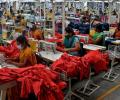
Enthused by higher than expected GDP numbers in the fourth quarter of 2022-23, Chief Economic Adviser (CEA) V Anantha Nageswaran on Wednesday said India's economic growth may exceed the initial estimate of 6.5 per cent in the current fiscal and the country can look for another year of solid economic performance.

...or just a Covid-era practice, asks Ajit Balakrishnan.

Big-ticket investments taking off is crucial for Kerala given the years it lost to labour militancy courtesy the same political forces currently in power, explains Shyam G Menon.

The growth is particularly remarkable because it comes at levels higher than during the pre-Covid times, notes Mahesh Vyas.

'80% of the rural and urban population don't have enough purchasing power.'
